

Coating process for battery cells replaces film wrapping
Two companies from North Rhine-Westphalia are revolutionizing battery cell production in the e-mobility segment
Partnership between Plasmatreat and Venjakob replaces costly film wrapping
Local expertise from East Westphalia-Lippe (NRW) pooled, innovative solution developed for international battery production: Plasmatreat GmbH (Steinhagen) and Venjakob Maschinenbau GmbH & Co. KG (Rheda-Wiedenbrück) are now making battery production more efficient and reliable thanks to a new process. Plasma-cleaned battery cells are given a special coating instead of an elaborate film coating to ensure reliable electrical insulation. Battery manufacturers benefit from the close proximity of the two companies, which work together to simulate processes under realistic conditions and manufacture small series.
The e-mobility segment is looking for solutions that further increase the reliability of batteries and improve safety. One starting point for optimization is electrical insulation. In the conventional way, battery cells, especially prismatic cells, are coated with a film. The process is costly and time-consuming and is prone to errors. Now an innovative process is making battery production more efficient, faster and more reliable: the battery cells are coated with a special paint instead of foil. The companies Venjakob and Plasmatreat have pooled their expertise to achieve this.
Plasmatreat - perfect paint adhesion through ultra-fine cleaning
Plasmatreat is the global market leader for atmospheric plasma technology and has developed the open-air plasma technology. In this case, it is used for ultra-fine cleaning of the bare battery cell and enables reliable, long-term stable paint application. The open-air plasma is applied precisely to the metals surface of the battery cells in a plasma treatment unit (PTU) under atmospheric pressure using simple compressed air and electricity through specially developed nozzles. Compared to conventional cleaning methods, the process is significantly more environmentally friendly, selective and inline-capable. The surfaces of the battery cells are reliably cleaned of wafer-thin layers of dust and residual traces from the production process, e.g. oil or grease. This allows the protective coating to be applied without any gaps. Long-term adhesion is achieved.
Venjakob - contactless coating, minimizing sources of error
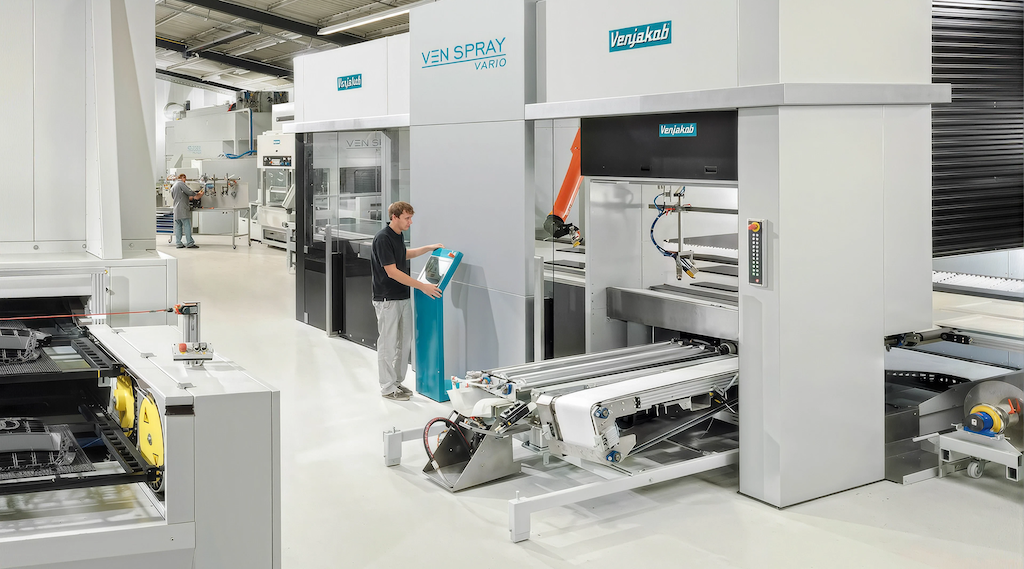
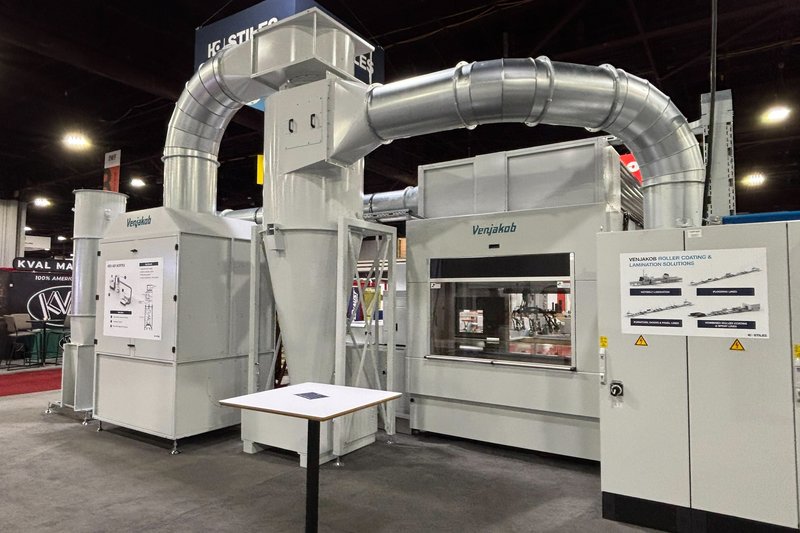
The mechanical engineering company Venjakob, a specialist in coating lines, has developed a fully automated system for a continuous contactless coating process. Here, the battery cells in various formats are coated with a 100% UV coating after ultra-fine cleaning using open-air plasma. A specially developed tool carrier ensures that sensitive areas and the electrical poles of the battery cells are reliably protected from overspray. As the process requires no gripping, turning or further materials handling, the risk of damage to the battery cells is minimized. The non-contact process also allows for increased production speed. Thanks to the immediate curing of the UV coating, the cells can be processed directly. This speeds up the entire battery manufacturing process.
Innovation lies in the conveyor systems
In order to dispense with a workpiece carrier, the belt conveyor was provided with a raised track onto which the cell modules are placed at a small distance so that the parts to be protected, namely the electrical poles, the degassing valve and the DMC code, are safely protected from overspray during the entire coating process. The cell modules are guided through the process via a belt conveyor. Before the first coating cycle, they are automatically positioned on the following belt conveyor by a mechanical guide. In the coating booth, they are coated from five sides using five fixed spray guns in a continuous process. No gripping, no turning, no materials handling - and therefore no risk of damaging the sensitive cell modules. After industrial finishing, the battery cells are automatically conveyed through a UV drying channel to dry. From there, they are transported to the next coating pass and then to another special UV drying channel via a belt conveyor. Finally, the finished coated battery cells are transported to the outlet via a driven belt conveyor.
Successful alternative manufacturing process
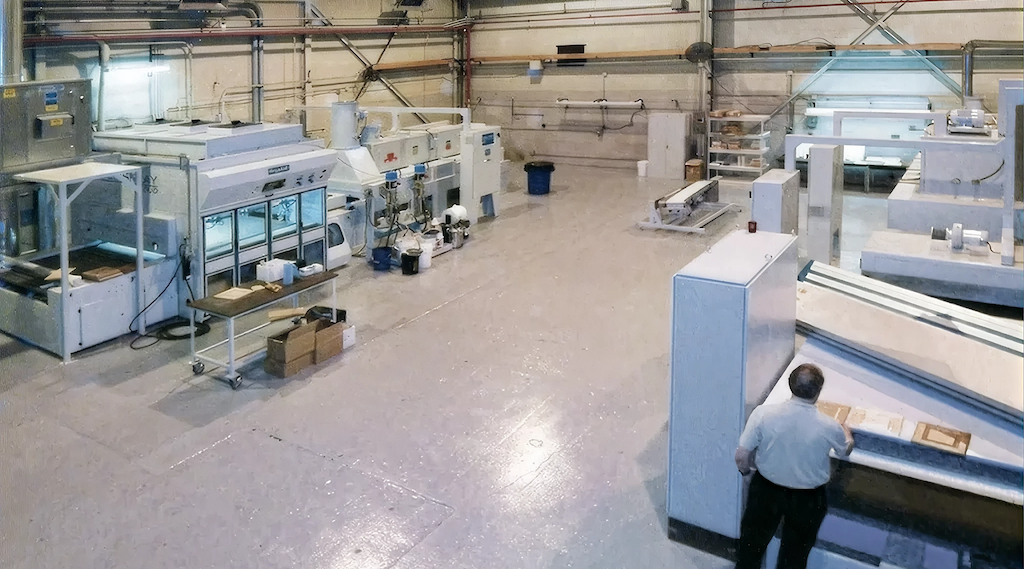
Various analyses confirm the high effectiveness of the innovative insulating coating, which achieves adhesive strength values of over 15 MPa in tensile shear tests. The two partners attribute the success of the project above all to the best possible match in key aspects. These include comprehensive technological expertise, uniformly high quality standards, flexible adaptability to changing customer requirements and intensive communication based on mutual trust. In this case, the joint customers also benefit from the close proximity, which has made it possible to demonstrate and evaluate ultra-fine cleaning and coating in a near-series process in Steinhagen and Rheda-Wiedenbrück.

Your contact for the press release
If you have any questions about this press release, please do not hesitate to contact us.

Gert große Deters
Business Unit Manager for General Industry & Automotive
Telephone: +49 5242 9603-184E-mail: ed.bokajnev@sretedessorg.treg


