

Automated coating as a step into the future of staircase construction
A medium-sized joinery in the staircase construction segment has acquired an automatic coating system from Venjakob, setting a milestone for the future direction of the family business. Individual customer requests for the coating of wooden stair treads can now be realized just as quickly as coating orders for external interior construction companies.


"We are future-proofing the company for the next generation." The medium-sized family business ETS Treppenbau und Schreinerei GmbH currently employs 26 people at its Dingdorf site in Rhineland-Palatinate. ETS is one of the enviable craft businesses that do not have to worry about company succession. In addition to the managing directors Albert and Klaus-Peter Ernzer, the three sons are already working in their parents' business - two of them, Jonas and Lukas Ernzer, already have their master craftsman's certificate "in the bag". The company specializes in the construction of wooden staircases, primarily for private customers, prefabricated house builders and joineries.
First thoughts on automation
"Stairs that inspire" is the motto of this long-established company. Their strength lies in customized staircases. The Ernzers are known and recommended for this in the region. But they are also feeling the effects of the skills shortage. "You have to find good industrial finishers first," says Alfred Ernzer. "That's why we started thinking about automating the processing of surfaces," adds Klaus-Peter Ernzer. For the Ernzers, increasing quality and saving time played an overriding role in the decision-making process. "Our customers increasingly want the surfaces of their stair treads to match the color of the interior, especially the existing floors. For this purpose, colored stains or RAL colors are used as water-based UV varnish, which we were previously only able to varnish on the manual spray stand," reports Alfred Ernzer. The company's existing roll coating lines could only be used to apply clear coat. "Here, too, we had to do additional manual work to paint the edges," says Ernzer, describing the effort involved, which, to everyone's delight, is now a thing of the past. With the new coating system from Venjakob, everything can be coated, stained and dried in equal measure. "The entire coating system - from the spraying machine with three paint supply lines to the UV drying channel - is designed for the use of the desired water-based UV coatings and water-based stains and complies 100% with EU environmental directives. In terms of time savings, Alfred Ernzer says: "We could now easily double the number of stair treads we finish."
First major order for chipboard has been received
But the vision is a different one. The new Venjakob coating lines, which are precisely tailored to Ernzer's needs, are to be utilized beyond the company's own stairs. "We want to accept more external painting orders for furniture construction," says Klaus-Peter Ernzer. The first major order has already been received: 5000 square meters of chipboard for interior fittings are to be painted. The system, which allows quick color changes and has short drying times, is predestined for this. Ernzer is also impressed with the surface quality. "The uv curing in industrial coating, which can now also be used for the colored surfaces, makes the paint much more resistant and scratch-resistant."
System suitable for new hall construction
In future, the surface treatment process was to take place separately in its own hall. A new hall with an area of approx. 500 square meters was planned for this purpose. The ceiling height was low, as the hall was built directly onto the existing workshop at the same height. The coating line was to be designed to save space accordingly. The entire Venjakob system was built in a U-shape with rake angle transfer. Workpieces with the following dimensions in length, width and height can be processed: minimum 300 mm x 100 mm x 10 mm, maximum 5300 x 1300 x 100 mm.
15 minutes for a complete cycle
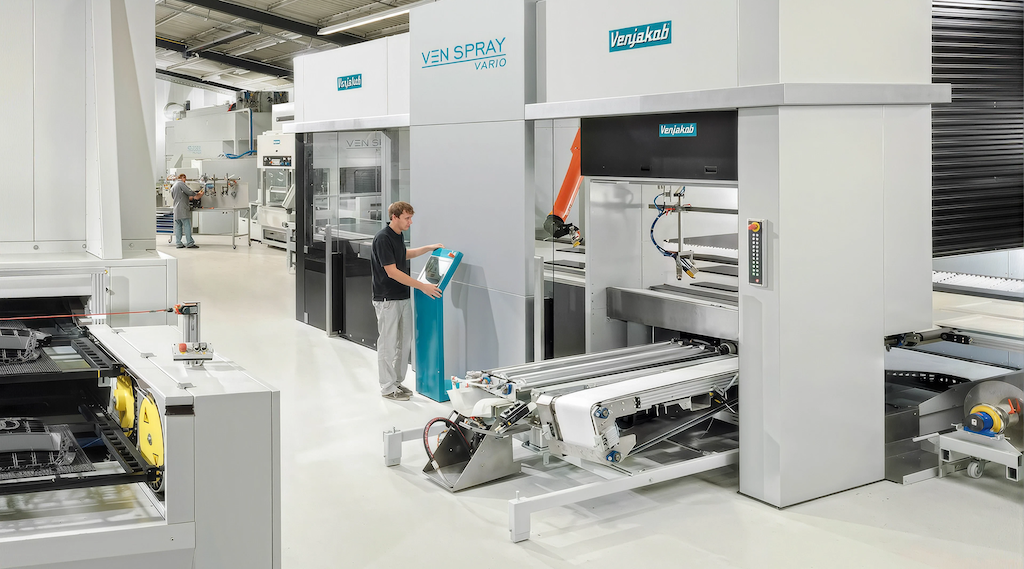
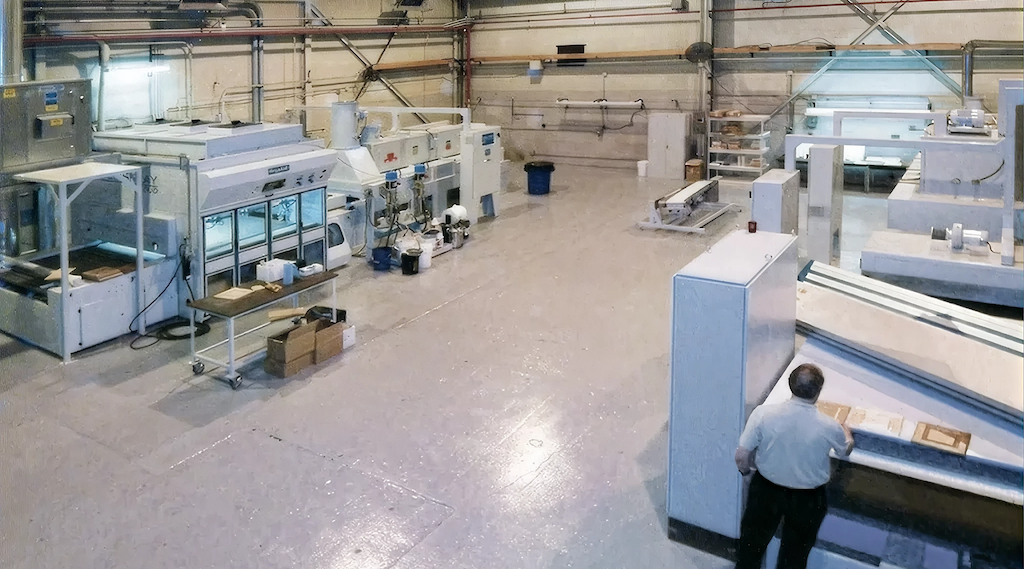
the system is structured as follows: The workpieces are manually placed on the belt conveyor. Length markings are applied to the workpieces to simplify the process. First, the workpieces are automatically preheated via an IR preheating module to remove dust. They are then conveyed to the Ven Spray Smart spraying machine. This is equipped with one paint supply line each for UV clear lacquer, UV color lacquer and stain. Industrial finishing is carried out with four spray guns, which coat the surfaces and edges in equal measure. After coating, the workpieces are conveyed via a temperature-resistant belt conveyor through a covered evaporation zone into the water-heated drying channel. This consists of two nozzle drying channels, which are set up on an angled transfer for transferring the batches. The workpieces coated with clear or colored lacquer are cured in the subsequent UV drying channel. "The aim was for the workpieces to come out of the system dry after the base coat with paint or clear lacquer so that the intermediate lacquer sanding and then the top coat can take place," explains Christian Schulze, the sales engineer at Venjakob who looks after the customer ETS. The time required for an industrial finishing cycle, from placing the workpieces on the machine to removing them, is around fifteen minutes.
Specialist knowledge and a good reputation are decisive
The system is easily controlled via a central control unit, which is used to call up stored coating recipes. "All important parameters, such as drying times, are stored in the recipe management system. We have carefully coordinated these parameters with the customer and the paint manufacturer," says Christian Schulze.
Ernzer agrees that the investment has paid off. "Yes, there were cheaper offers. But the decisive factor for us was the expertise of the Venjakob employees and their good reputation. The system was planned and implemented perfectly in line with our needs. The price-performance ratio is right for such a system," confirms Alfred Ernzer.