

Industrial spray coating for demanding surfaces
Industrial spray coating is one of the most precise processes for the industrial coating of wood, furniture, building elements, plastics, metals and glass. The quality of the material application determines the look, feel and protective function of a surface. At Venjakob, we develop automated spray coating lines that ensure controlled paint application, low reject rates and efficient use of materials. Industrial robotics and digital process monitoring support consistent quality, even with varying geometries and quantities.
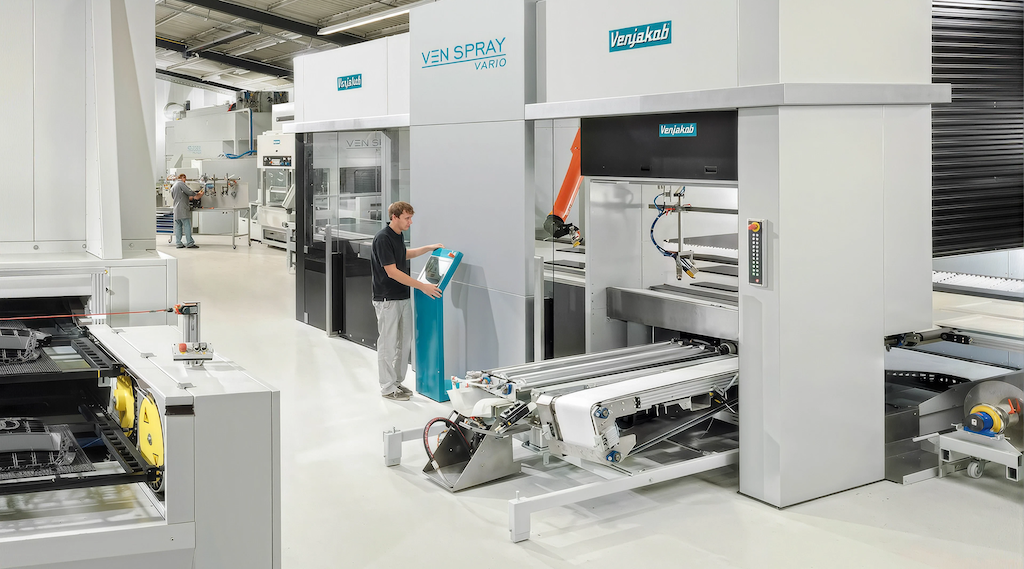
VEN SPRAY spray coating lines
Our VEN SPRAY spray coating lines have a modular design and can be adapted precisely to different production requirements. They enable uniform atomization, high material efficiency and flexible parameterization via the control system. We integrate VEN SPRAY systems seamlessly into complete painting lines - from pre-treatment and materials handling to drying and exhaust air purification.
To the spray coating lines


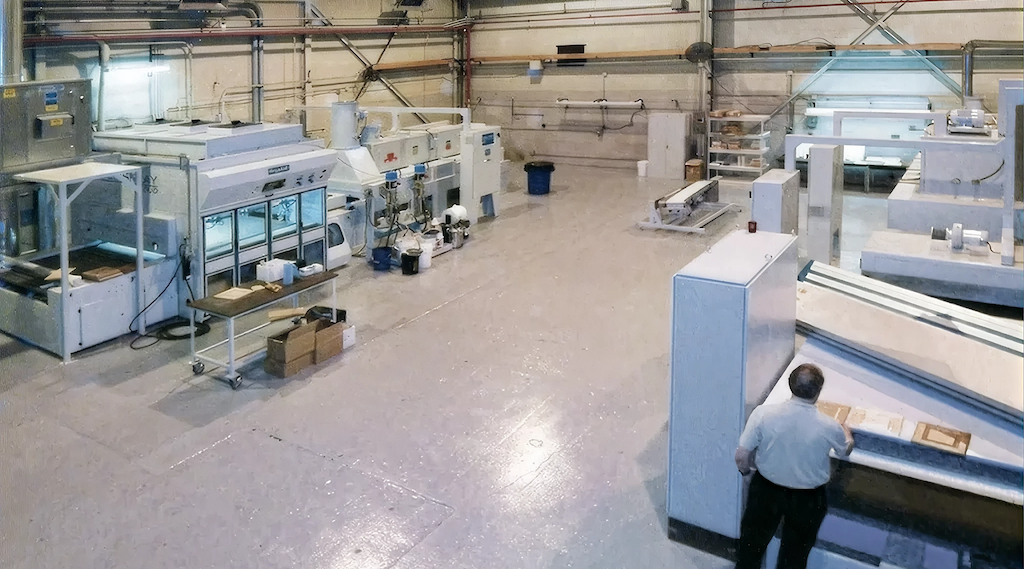
The industrial spray coating process chain
Efficient industrial spray coating is only achieved when all upstream and downstream process steps are seamlessly interlinked. From safe workpiece guidance and optimally prepared surfaces to drying, exhaust air purification, industrial robotics and intelligent process monitoring - each step influences the quality of the final result. The Venjakob process chain shows how these individual steps can be combined in a modular way, depending on the material, throughput and degree of automation.


Robot-assisted spray painting
Different spray painting processes are used depending on the surface, paint system and quality requirements. At Venjakob, we integrate all relevant processes and select the optimum technology for the material, geometry and series requirements.


Industrial spray coating: How it works
A precise spray painting process is achieved through the interplay of workpiece detection, optimum paint parameters and a stable, guided application. Industrial robotics or automatic spraying systems ensure uniform coating thicknesses, while air guidance and overspray separation ensure quality in the booth. The process can be fully automated and can be flexibly configured for different geometries and materials.
Workpiece detection
The geometry is captured using a scanner or camera, and the trajectories are automatically calculated and precisely adapted to the workpiece.
Material preparation
Pressure, material quantity and viscosity are stably controlled - for constant paint application regardless of temperature or material batch.
Paint application / atomization
Airless, airmix or electrostatic spraying systems apply the coating in a controlled manner. Industrial robotics enable reproducible paths and defined coating thicknesses.
Air flow & overspray separation
Homogeneous air flows keep the spray mist in the process chamber, while wet or dry separation reliably removes the overspray.
Transfer to the next process step
The components leave the cabin without surface contact and go directly into flash-off after coating in industrial production, IR, UV or coating drying systems.
Industrial spray coating: sustainable and safe
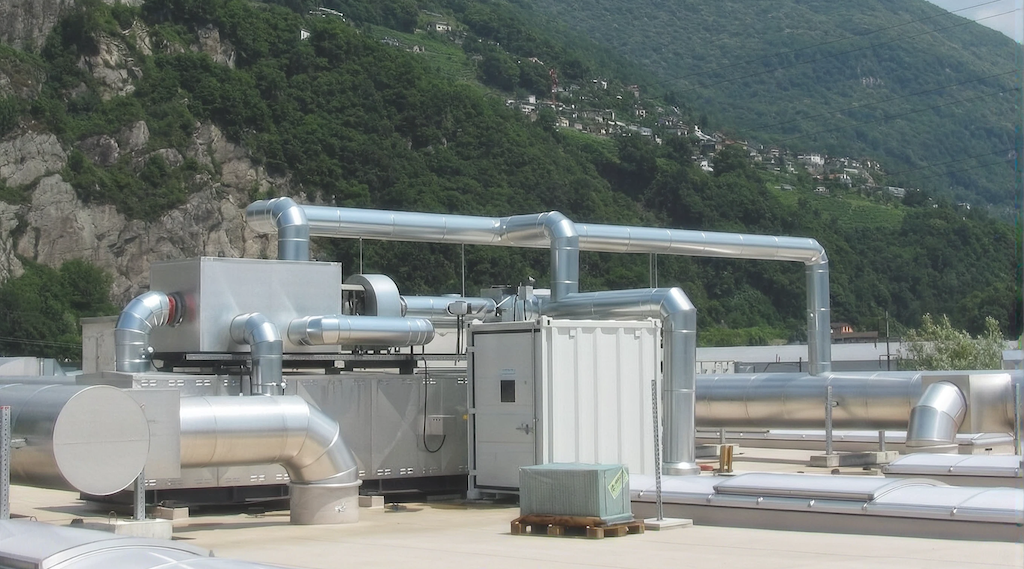
Sustainability is becoming increasingly important in industrial finishing. Energy-efficient air and paint flow reduces consumption and emissions. At the same time, safe system technology ensures high process quality and protection for operating personnel. With exhaust air systems, systems meet legal requirements for VOC reduction and enable energy-optimized production conditions.
- Energy-efficient air flow
- Reduced VOC emissions
- Optimized paint consumption
- Safe filter and exhaust air technology
- Explosion protection and occupational safety


Future trends in spray painting
Industrial spray painting is developing rapidly because production lines today demand greater precision, shorter changeover times and verifiable quality stability. Modern systems are increasingly merging with digital systems: Sensor technology, AI-supported analysis and adaptive robot movements make painting processes predictable, documentable and optimizable. At the same time, new paint systems and energy-efficient application technologies are emerging that reduce material consumption and VOC emissions.
How does the airflow affect the quality of industrial spray coating?
Stable air flow prevents turbulence in the spray jet, minimizes overspray and ensures uniform coating thicknesses. It is crucial for the gloss level, structure and flawlessness of the surface. Systems are designed so that paint mist is captured efficiently and air is conditioned cleanly.
What defects occur during industrial spray coating - and how can they be prevented?
Typical faults are orange peel, runners, wetting faults or uneven layer thicknesses. These are caused by unsuitable parameters, unstable air flow or incorrect nozzles. Precise process control, automatic monitoring and robot-supported movement paths minimize these risks.
In which industries is industrial spray coating used?
Industrial spray coating is used in the wood and furniture industry, automotive, aviation, component manufacturing, metals processing, plastics technology and glass finishing.
For which materials is industrial spray coating suitable?
Wood, MDF, metals, aluminum, plastics, composite materials, glass and building elements can be coated using the spray process. The right process and a suitable paint are crucial.
What applications can be realized with industrial spray coating?
Typical applications include furniture parts, doors, profiles, vehicle components, housings, technical components, fronts and special surfaces. Functional coatings such as adhesion primers or protective coatings can also be sprayed.
What is industrial spray coating?
Industrial spray coating is a process in which paint is finely atomized and applied evenly to a surface. It is suitable for flat and complex geometries and is used in automated painting lines. Modern systems reduce overspray, improve surface quality and enable reproducible results.
We would be happy to advise you
Would you like to find out more about our systems, processes or solutions - or do you already have a specific project in mind? Our contacts are on hand to provide you with expert advice, technical expertise and many years of experience.

Gert große Deters
Business Unit Manager for General Industry & Automotive
Telephone: +49 5242 9603-184E-mail: ed.bokajnev@sretedessorg.treg

Christian Streit
Head of Wood | Building Materials Division
Telephone: +49 5242 9603-162E-mail: ed.bokajnev@tierts.naitsirhc


